
College students are navigating a financial landscape that looks very different from the one their parents faced. New digital tools have led many students to seek faster and more accessible ways to manage their money. Instead of turning to traditional advisors, today’s learners often open an app or type a question into an AI chatbot to make sense of budgeting, saving and long-term planning.
To better understand this shift, a nationwide survey of 290 college students was conducted on behalf of Northern Kentucky University (NKU). Each of the respondents had used AI tools to guide at least one financial choice. Their responses show how quickly algorithms and automated platforms have become part of everyday financial decision-making in higher education. Students today value real-time information, want greater control over personal finances and are willing to let technology take on a larger role in financial literacy.
Key Takeaways
- 83% of college students use ChatGPT to help manage their money.
- 69% of college students have used only AI tools for financial advice, without ever consulting a human advisor.
- Only 29% of college students have followed AI-generated financial advice that they later regretted.
- 71% of college students said AI tools have improved their savings and financial literacy, with nearly half saving between $500 and $2,500 thanks to AI-powered budgeting apps.
- 41% of college students said AI tools have helped them avoid going into debt.
AI Tools College Students Use to Manage Money
Students are turning to AI technologies to simplify money management and build confidence in their financial decisions. Many describe these tools as a game-changer because they streamline tasks that once required multiple websites or professional appointments.
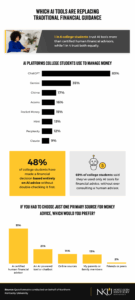
More than eight in 10 college students (83%) said they use ChatGPT to help manage their money, which shows how common AI-powered tools have become for everyday financial tasks. A large group of students (69%) also said they used AI tools for financial advice without speaking with a human advisor. However, many are also aware that AI can make mistakes.
More than two in three (68%) said they always or frequently double-check the financial advice they receive from AI tools. Only 29% of students said they later regretted following AI-generated advice.
Although regret was not the most common experience, it shows that some recommendations produced by AI-powered tools may not align with a student’s financial situation. Students who rely on AI tools can take simple steps to stay informed and avoid missteps, including:
- Checking unfamiliar advice with a trusted financial source, such as a bank representative or a financial wellness resource on campus
- Comparing AI-generated recommendations with reputable financial aid or student loan information
- Using AI platforms as a starting point rather than treating them as final decision-makers
How AI Tools Help Students Save and Stay Out of Debt
College students report significant financial benefits from using AI-powered tools to manage everyday expenses. Many say that the ability to automate key tasks improves accuracy and reduces stress while helping them stay accountable to long-term goals.
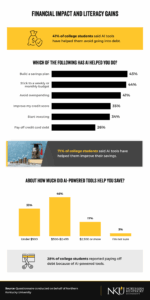
A large share of college students (71%) said AI tools have improved their financial literacy, and the same percentage reported improvements in their savings. Nearly half (46%) saved between $500 and $2,499 with AI-powered tools, and 17% saved $2,500 or more. While ChatGPT was the most widely used, the students most likely to save between $500 and $2,499 were Perplexity (65%) and Gemini (53%) users.
Students were most comfortable with allowing an AI-powered tool to automate tracking expenses (65%), creating budgets (63%) and categorizing purchases (45%). Fewer felt ready to automate the following tasks:
- Improving or monitoring credit score (38%)
- Paying down debt (34%)
- Paying recurring bills (33%)
- Making basic investing decisions (24%)
- Transferring money to savings (23%)
More than half of students (55%) said AI-generated budgeting plans are easier to follow than human-created ones. About two in five students (41%) reported that AI tools helped them avoid taking on new debt. Among students who used AI-powered tools to pay off debt, 56% paid off between $500 and $4,999, 27% paid off less than $500, and 16% paid off $5,000 or more.
Social Media’s Role in AI Finance Adoption Among Students
Social platforms have become a place where college students discover new AI-powered financial tools. For example, short videos, peer recommendations and influencer content are affecting which calculators, apps and chatbots students choose to try. Social media is now serving as both a source of ideas and a catalyst for new financial habits.
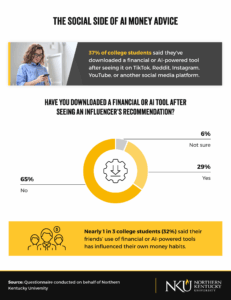
More than one in three students (37%) said they downloaded a financial or AI-powered tool after seeing it on TikTok, Reddit, Instagram or YouTube. Nearly one in three (32%) said their friends’ use of financial apps and AI tools influenced their own money habits.
Students also reported trying a range of trending financial strategies they saw on social media platforms. These challenges and techniques appeared across TikTok, YouTube and other channels and often encouraged students to experiment with new ways of saving or managing money. Here are the top trends and how many students have tried them.
- No-spend challenge (35%): Encourages students to avoid all nonessential purchases for a set period, helping them cut back on impulse spending and build awareness of their habits
- Buy now pay later stacking (25%): Involves using multiple BNPL services at once, which can create short-term flexibility but may lead to confusion about repayment schedules
- Cash stuffing (24%): Divides income into labeled envelopes for expenses like groceries or transportation, giving students a physical way to track spending
- Credit card churning (17%): Uses credit card sign-up bonuses or reward cycles to earn points, although it can become costly without careful tracking
- Loud budgeting (14%): Focuses on openly communicating financial boundaries to avoid unnecessary spending
- 100 envelope challenge (13%): Asks students to fill 100 numbered envelopes with the corresponding dollar amount over time, turning saving into a structured routine
Strategies like these gain traction when they are easy to start and feel achievable. Trying them alongside trusted financial resources can help students understand what works for their situation and avoid choices that create unnecessary risk.
The Rise of AI-driven Financial Literacy
College students are reshaping their financial lives through AI-powered tools that provide on-demand support, personalized guidance and automated decision-making. These platforms introduce learners to new ways of managing money, monitoring spending and building stronger financial habits. Many students now trust AI technologies for things like budgeting, avoiding debt and understanding repayment strategies.
As the use of AI systems continues to grow, colleges may consider how financial literacy programs can evolve alongside generative AI, chatbots and machine learning innovations. Empowering students to use these tools responsibly will help them understand the potential benefits while also recognizing the importance of data privacy and sound judgment. The next generation of financial knowledge is becoming AI-driven, and higher education will play a critical role in preparing students for that future.
Methodology
A questionnaire was conducted among 290 college students on behalf of Northern Kentucky University to explore how students are turning to AI tools, social platforms and budgeting apps for financial advice and decision-making. All respondents had used AI tools (e.g., ChatGPT or other chatbots) to make at least one financial decision. Data was collected in November 2025. Because this was a non-probability, online sample, results should be considered non-scientific and exploratory and are not intended to represent all U.S. college students.
About Northern Kentucky University
Northern Kentucky University offers flexible online degree programs that prepare students for data-driven careers in business and technology. Through NKU’s online Master of Science in Information Systems (M.S.I.S.) – Business Analytics program, learners develop expertise in data strategy, analytics and information systems that support effective decision-making in organizations. Through practical coursework and real-world applications, NKU empowers students to succeed in a rapidly evolving digital economy.
Fair Use Statement
Information from this article may be shared for noncommercial purposes only. When citing or redistributing this content, please include proper attribution and a link to Northern Kentucky University.