

An educational diagnostician evaluates students for learning difficulties. As a certified specialist, they develop individualized strategies to support academic success.
This career path is ideal for licensed teachers, special education professionals and others passionate about helping students with varied learning needs. With expertise in testing, diagnosis and program development, educational diagnosticians play a vital role in shaping an individual education plan (IEP) and tailoring instruction to ensure meaningful progress.
The online Education Specialist (Ed.S.) in Teaching and Leading – Special Education program at Northern Kentucky University (NKU) prepares educators to advance their expertise in assessing and supporting students with exceptionalities. This online, CAEP-accredited program emphasizes leadership, collaboration and evidence-based strategies for working with exceptional learners. By earning your Ed.S. degree, you can qualify for advanced teaching roles and make a lasting difference in the lives of students with special needs.
Why Become an Educational Diagnostician?
Educational diagnosticians help identify learning challenges and administer diagnostic assessments. Unlike school psychologists, who focus more broadly on mental health and behavior, educational diagnosticians specialize in academic assessment and the development of IEPs. Their primary goal is to ensure students receive appropriate support in accordance with special education guidelines.
The median annual wage for special education teachers is $64,270, according to data from the U.S. Bureau of Labor Statistics (BLS), and earnings may rise with experience or depending on where educators work. Demand is consistent across public schools, private schools and school districts, especially in areas with growing student populations and increasing special needs diagnoses.
What Are the Key Roles and Services Provided by Educational Diagnosticians?
Educational diagnosticians provide services that help students with learning disabilities and special needs during their academic journey. They play a key role in:
- Conducting educational assessments: They administer standardized tests to evaluate learning difficulties, disabilities and developmental delays.
- Creating and managing IEPs: Educational diagnosticians design and maintain individualized education plans tailored to each student’s unique needs.
- Using assistive technology: Recommending tools and resources that improve learning outcomes.
- Supporting students with exceptionalities: These professionals collaborate with teachers and families to adjust instruction and make accommodations as needed.
- Delivering special education services: They ensure compliance with local and federal regulations while providing ongoing academic support.
Educational diagnosticians’ work directly influences students’ eligibility for services and helps educators build more inclusive classrooms. They also serve as vital liaisons between families, educators and state agencies to ensure consistent support in various educational settings.
Educational Requirements and Certification Pathway
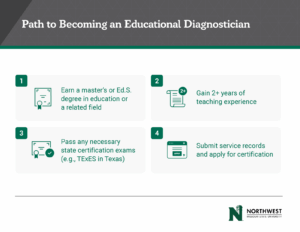
Becoming an educational diagnostician requires meeting specific academic and certification standards, which vary slightly by state. Generally, they follow a consistent pathway. Candidates typically need a graduate degree, field-specific coursework, hands-on practicum experience and state-approved certification.
Degree Requirements
Most educational diagnosticians hold a Master of Education (M.Ed.) or a postgraduate degree, such as an Ed.S., in a related field. Qualifying disciplines include special education, psychology, counseling and other education-focused areas. These degrees must be earned from accredited institutions and typically include coursework aligned with state board requirements for diagnostician certification.
Coursework and GPA Expectations
Graduate and postgraduate programs for educational diagnosticians include both theory and practical elements. Core courses may include:
- Diagnostic assessment
- Individual education plan development
- Research-based teaching
- Applied behavior analysis
- Intellectual disabilities and orthopedic impairments
- Special education law
- Use of assistive technology
Programs generally require 30 credit hours, with a minimum GPA of 3.0 for graduation and certification eligibility. Some institutions also require a passing score on entrance exams or prior teaching certification for admission.
What Are the Certification and Licensure Requirements for Educational Diagnosticians?
The requirements for certification as educational diagnosticians vary by state, and some states offer a dedicated credential, including Texas, New Mexico and Louisiana.
So, while the Ed.S. in Teaching and Leading – Special Education online program at NKU strengthens educators’ expertise in assessment and individualized instruction, it does not automatically lead to state certification as an educational diagnostician. These states maintain a dedicated educational diagnostician credential, typically requiring:
- A valid teaching license
- A master’s or higher degree
- Verified classroom teaching experience
- Completion of an approved diagnostician preparation program
- A passing score on a state-issued exam
Requirements and titles vary by state. For example, the Texas Education Agency (TEA) and the State Board for Educator Certification (SBEC) oversee the state’s credentialing standards. To become a certified educational diagnostician in Texas, candidates must:
- Hold a valid teacher certification
- Possess a master’s degree granted by an accredited institution of higher education
- Complete an accredited educational diagnostician certification program
- Submit a verified service record showing at least two years of teaching experience
- Pass the TExES Educational Diagnostician exam (EC-12)
Other states may use different titles, such as special education diagnostician, educational assessment specialist or school psychologist, each with its own certification routes and terminology. The National Certification of Educational Diagnosticians (NCED) also offers a voluntary credential recognized across multiple states, though individual state licensure still governs who can practice in public schools.
Graduates of NKU’s Ed.S. online degree gain advanced skills in diagnostic assessment, IEP development and special education leadership. These are key qualifications for roles that overlap with educational diagnostician responsibilities.
Keep in mind that specific certification steps ultimately depend on where you plan to work. Before enrolling, verify your state’s credentialing process for educational diagnosticians or equivalent roles.

What Are the Online Ed.S. Program Structure and Enrollment Process?
The Ed.S. in Teaching and Leading – Special Education online degree is structured for flexibility. NKU offers a 100% online format with accelerated terms (typically seven weeks). This program offers six start dates each year on an accelerated seven-week schedule. Application requirements generally include:
- A completed application form and $40 fee (waived for NKU alumni or active-duty and veteran military members)
- Submission of official transcripts from prior colleges or universities; one transcript must verify completion of a master’s degree in education or in the subject area tied to the applicant’s teaching certificate
- Proof of teacher certification and service record (Rank 2 or out-of-state equivalent)
- A minimum GPA of 3.0 in master’s level coursework
- Financial aid application (if applicable)
The 30-credit program can be finished in as few as 18 months, depending on the course load. Students build toward Rank 1 teacher certification in Kentucky, a credential that can advance salary rank and leadership eligibility in the state.
Assessment Methods and Practicum Experience
While NKU’s online Ed.S. degree is not solely a diagnostician licensure track, the program prepares educators to lead special education initiatives and strengthen assessment and instructional practices across K-12 settings. Students study a range of evidence-based methods for identifying and supporting learners with disabilities, autism and other special needs. Coursework covers assessment interpretation, IEP development, instructional design and collaboration with multidisciplinary teams.
The program includes job-embedded and clinical components that serve as a practicum experience, allowing educators to apply what they learn in real school settings. Students complete guided, practical work in their own classrooms or districts under the mentorship of NKU faculty. This hands-on component strengthens their ability to evaluate teaching practices, interpret data, and maintain compliance with the Individuals with Disabilities Education Act (IDEA) and state special education standards.
Educational diagnosticians assess learning disabilities using standardized testing and observational data to identify learning profiles and determine eligibility for services. The practicum ensures that candidates gain real-world experience applying these methods to support meaningful outcomes.
Professional Development and Career Advancement
Maintaining certification as an educational diagnostician usually requires ongoing training, like completing continuing education hours or periodically renewing credentials. Many states also mandate documentation of a current service record in the field.
Career opportunities include roles such as lead diagnostician, special education coordinator or director of assessment. Some professionals transition into administrative positions within a school district, while others choose to specialize further. Areas of specialization might include autism intervention, assistive technology or bilingual educational assessment, which is especially valuable in districts with diverse student populations. For graduate students who want to expand their impact beyond classroom teaching, the diagnostician role opens the door to leadership opportunities within the field of special education and related support services.

Launch Your Career as an Educational Diagnostician
Building a career as an educational diagnostician positions you to apply assessment and collaboration skills that improve student support across K-12 settings. These professionals help identify learning barriers to ensure that all learners, regardless of ability, receive the educational resources they need to succeed.
NKU’s online Ed.S. in Teaching and Leading – Special Education degree enables working professionals to advance without stepping away from their careers. Whether you are currently in the classroom or moving from a related field, the right degree program can prepare you for a valuable, in-demand position in special education. To learn more, prospective students should explore enrollment options, compare programs and request information about upcoming start dates.
Learn more about NKU’s online Ed.S. in Teaching and Leading – Special Education program.