
Artificial intelligence has quickly become one of the most transformative tools in both education and the workplace. Students and professionals alike are discovering that platforms like ChatGPT, Claude and Gemini can help them save time and think more critically. Yet, as reliance on AI grows, questions are emerging about how it affects human performance, learning outcomes and even long-term earning potential.
A questionnaire of 1,000 U.S. respondents was conducted on behalf of Northern Kentucky University (NKU). The participants included 700 employed adults and 300 current students not affiliated with NKU. The questionnaire aimed to examine how individuals are integrating AI-powered tools into academic and professional settings. The results provide insight into how AI technologies are influencing contemporary education and career development.
Key Takeaways
- Only 38% of students said they always double-check the accuracy of AI-generated academic work.
- 47% of frequent AI users said their academic performance improved in the past year, more than double the share of non-users (23%).
- Students with lower GPAs were more likely to be non-AI users: 11% of infrequent or non-users reported a GPA below 3.0, compared to just 6% of frequent AI users.
- Frequent AI users earn about 28% more than those who rarely or never use AI, averaging $67,525 annually compared to $52,681 among non-users.
- Frequent AI users were twice as likely to report improved job performance over the past year (51%) compared to those who rarely or never use AI (25%).
How Students Are Integrating AI Into Everyday Learning
As AI tools become increasingly accessible, students are incorporating them into their academic routines. For many, these tools have become as essential as search engines, changing how they research, write and study.
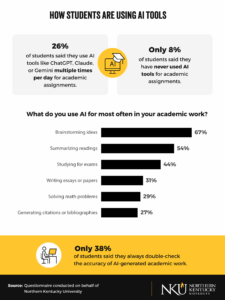
More than one in four students (26%) said they use AI tools like ChatGPT, Claude or Gemini multiple times per day for coursework, while only 8% said they have never used them at all. ChatGPT leads the way with 70% of students naming it as their primary platform, used more than four times as often as the next most popular tool, Gemini (16%).
Students reported using AI primarily to brainstorm ideas (67%), summarize readings (54%) and prepare for exams (44%). However, the study also revealed concerns about information accuracy and academic integrity. Just 38% of students said they always verify AI-generated outputs before submitting or using them in assignments.
Academic Gains Among Frequent AI Users
The data shows a clear link between AI use and improved academic performance. Nearly half of frequent AI users (47%) said their grades improved in the past year, compared to only 23% of students who rarely or never use AI.
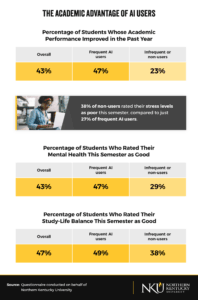
Beyond grades, frequent AI users also reported stronger well-being and balance. Nearly half rated their study-life balance (49%) and mental health (47%) this past semester as good, versus 38% and 29% among less frequent users.
Additionally, students with lower GPAs were disproportionately among those who do not use AI. Eleven percent of infrequent or non-users reported a GPA below 3.0, compared to just 6% of frequent AI users. These findings suggest that responsible AI use may complement traditional study habits and help students manage workloads more effectively.
How Professionals Are Leveraging AI for Career Success
AI adoption is not limited to high school and college students. Professionals across industries are integrating generative AI into their daily routines, most often for brainstorming, writing emails and conducting project research.
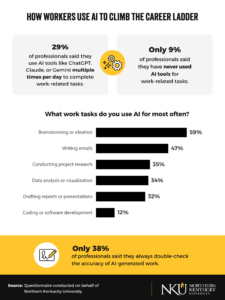
Nearly three in 10 professionals (29%) reported using AI tools like ChatGPT, Claude or Gemini multiple times a day, while only 9% said they have never used them for work. ChatGPT again dominates usage, with 70% identifying it as their primary AI tool. Gemini followed at 16%.
Interestingly, Gen X professionals led all generations in the frequent use of AI tools, at 38%. Only 21% of Gen Z workers reported using them multiple times daily, which was the lowest among all age groups. This generational difference may indicate that older professionals view AI as a tool for efficiency and advancement, while younger workers are still exploring how best to integrate it into their workflow.
AI Use and the Performance-Pay Divide
Further workplace findings reveal that regular AI use is closely associated with improved well-being, higher confidence and stronger financial outcomes. Frequent AI users were twice as likely as non-users to report improved job performance over the past year (51% vs. 25%).
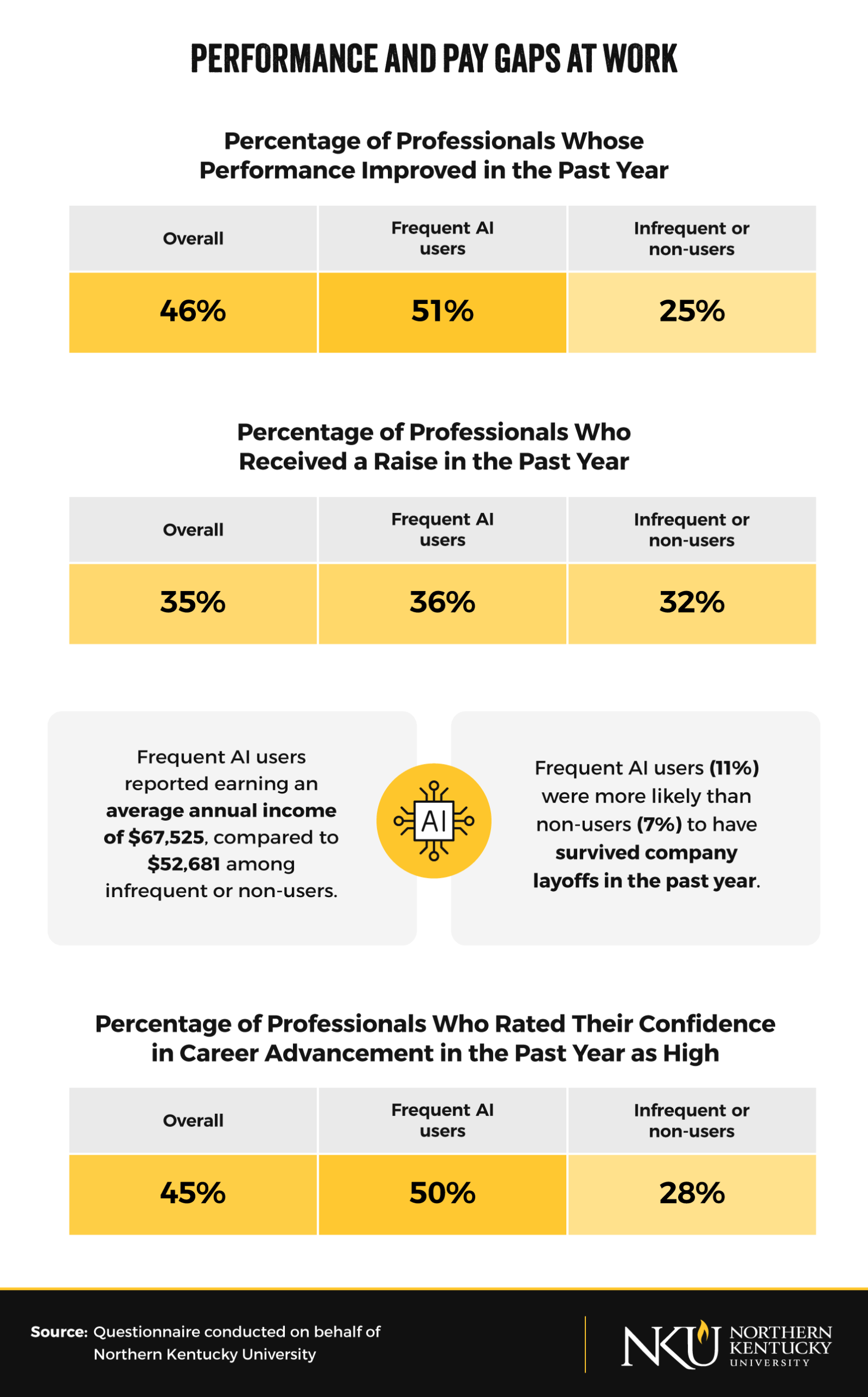
People who frequently used AI at work also earned substantially more. Their average annual income was $67,525, compared to $52,681 among those who rarely or never used AI. Frequent users were more likely to report receiving a raise (36% vs. 32%) and expressed higher confidence in their career advancement potential (50% vs. 28%).
Well-being indicators followed a similar pattern. Only 13% of frequent AI users rated their mental health as poor, compared to 28% of non-users, and fewer users than non-users reported having high stress levels (23% vs. 35%).
Using AI Strategically: Frequently Asked Questions
Artificial intelligence in education continues to reshape how students and professionals learn, work and solve problems. As higher education institutions explore the impact of AI on academic and career outcomes, developing strong AI literacy is becoming essential.
The following questions offer practical guidance on how to use AI systems and applications effectively, understand where human judgment is required and create more personalized learning experiences that optimize both speed and accuracy.
Does using AI tools really improve academic performance?
According to the questionnaire, students who frequently used AI tools like ChatGPT and Claude were twice as likely to report improved academic performance compared to those who rarely or never used them. Many said AI-driven tools helped them organize coursework, summarize complex material and prepare for exams more efficiently. These benefits of AI can enhance student learning when used to complement critical thinking and human oversight.
Which academic or professional tasks benefit most from AI assistance?
AI in education is most effective for tasks that involve idea generation, outlining or summarizing information. In higher education, students can use AI applications to brainstorm essay topics, structure research papers or review readings before exams. Chatbots powered by machine learning algorithms can also provide adaptive learning support based on individual student needs. In professional settings, AI systems help streamline writing, data analysis and communication, allowing workers to focus on more complex problem-solving and creative work.
Where should human oversight remain essential when using AI?
While the function of AI systems is to process large data sets efficiently, human oversight is essential to ensure accuracy and fairness. Algorithms can help optimize learning processes, but they are only as high-quality as the data used to train them. Institutions are increasingly adopting policies and frameworks for generative AI in higher education to guide the responsible use of these tools.
Students and educators must evaluate AI-generated content critically, verify information and apply personal insight. Responsible use supports AI literacy and helps safeguard the integrity of student learning in academic settings.
How can users balance speed with learning and accuracy when using AI?
AI can enhance efficiency, but speed should not replace comprehension. The most effective learning experiences come from using AI as a first draft generator and then refining the output manually. Students might, for example, use AI to create study outlines and then expand each section with their own analysis. This approach preserves the benefits of AI while reinforcing understanding through active engagement and personalized learning.
Are employers rewarding AI proficiency in the workplace?
Possibly. The questionnaire found that professionals who frequently used AI tools earned about 28% more on average than those who did not. They were also twice as likely to report improved job performance and greater confidence in their career prospects.
Many employers now recognize AI literacy as a vital skill, supporting initiatives to train workers in artificial intelligence applications and ethical data use. As the future of AI unfolds, professionals who can integrate these systems effectively will be well-positioned for advancement.
What risks come with overusing AI?
Overreliance on AI can lead to skill erosion, especially in writing, research and decision-making. Algorithms can replicate bias or misinformation if datasets are incomplete or inaccurate. The most successful students and professionals will be those who understand both the benefits and the limitations of AI applications.
The AI Advantage: Preparing for a New Era of Learning and Work
The findings from this questionnaire highlight an emerging truth about modern education and the workplace: those who use AI tools effectively tend to see measurable benefits in performance, balance and even income. As usage grows, ensuring accuracy and maintaining core skills will be critical to long-term success.
The next chapter in AI integration will depend on how educators, students and professionals learn to balance automation with human expertise, a skill that will define the future of merit in both academia and the workforce. Those who approach AI as a complement to, rather than a replacement for, critical thinking and creativity will likely emerge as leaders in their fields.
Methodology
A questionnaire was conducted among 1,000 U.S. respondents (700 employed adults and 300 current college or graduate students) on behalf of Northern Kentucky University to examine how frequently they utilize AI tools such as ChatGPT, Claude and Gemini for academic, professional and career development tasks. Employed respondents were required to be currently working full-time or part-time; student respondents were required to be currently enrolled in a degree-granting program.
For this study, “frequent AI users” were defined as respondents who use AI tools “multiple times per day,” “a few times per week” or “a few times per month.” Data was collected in November 2025. Because this was a non-probability, online sample, results should be considered non-scientific and exploratory and are not intended to represent all U.S. workers or students.
About Northern Kentucky University
Northern Kentucky University offers flexible, fully online degree programs designed to prepare students for emerging fields and future-focused careers. NKU’s online Master of Science (M.S.) in Cybersecurity program equips professionals to protect data, networks and systems in an era of growing digital threats. As technology continues to evolve, NKU remains committed to providing accessible, career-relevant education for today’s learners.
Fair Use Statement
Information from this article may be shared for noncommercial purposes only. When citing or redistributing this content, please include proper attribution and a link to Northern Kentucky University.