

The Doctor of Nursing Practice (DNP) represents the highest level of clinical education in the nursing field. This degree equips registered nurses with the skills to strengthen healthcare systems and improve patient outcomes. For working professionals, online DNP programs offer a practical way to continue advancing their education while maintaining leadership roles in their organizations.
This guide helps nurses evaluate online DNP programs based on essential factors like accreditation, structure, curriculum and career outcomes. Most programs, especially at the post-master’s level, are designed for working professionals. They blend academic rigor with scheduling flexibility.
Northern Kentucky University’s Doctor of Nursing Practice Program is a CCNE-accredited, fully online doctoral degree program. Structured for nurses with a master’s degree or higher, NKU’s program includes courses in healthcare policy and systems leadership. It is ideal for professionals looking for advanced nursing leadership or nurse practitioner roles. Whether you are exploring BSN-to-DNP options or have already earned an MSN, this guide will help you determine your next step.
What Is an Online Doctor of Nursing Practice (DNP) Program?
An online Doctor of Nursing Practice program is a practice-focused doctoral degree that prepares advanced practice nurses for leadership in patient care, evidence-based practice and system-level innovation. Unlike research-heavy PhD programs, DNP degrees prioritize applied knowledge and clinical impact.
While some programs accept students with a bachelor’s degree in nursing (BSN-to-DNP), most are post-master’s tracks designed for those who already hold a Master of Science in Nursing. These DNP programs often attract advanced practice registered nurses (APRNs), clinical specialists and nursing executives aiming to move into or grow within leadership roles.
Program specifics can vary. However, common coursework includes:
- Informatics: Using data and technology to guide smarter clinical decisions and improve patient outcomes.
- Population health: Focusing on the health of entire communities and finding ways to close care gaps.
- Healthcare policy: Working to shape policies that drive meaningful changes across the healthcare system.
- Quality improvement: Finding practical, measurable ways to make care safer, more effective and more consistent.
Choosing accredited program is essential. Accreditation by the Commission on Collegiate Nursing Education (CCNE) ensures your clinical placements and practicum meet national standards. This is crucial for licensure, employer recognition and long-term credibility.
How to Evaluate Online DNP Programs
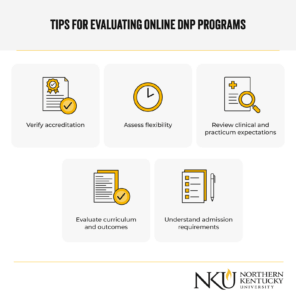
Selecting the right online Doctor of Nursing Practice (DNP) program takes thoughtful research and a clear sense of your professional goals. These five steps can help you evaluate your options:
- Verify accreditation: Always make sure that the program is accredited by a recognized body like the Commission on Collegiate Nursing Education (CCNE). Accreditation confirms that the degree program aligns with national standards and supports licensure eligibility. It also boosts employer confidence.
- Assess flexibility: Look for a program that fits your lifestyle. Features like asynchronous learning and part-time enrollment make it easier to manage coursework alongside your job and personal commitments.
- Review clinical and practicum expectations: Understand how the program handles clinical hours, including the total required, clinical practice standards, preceptor availability and assistance with placement logistics.
- Evaluate curriculum and outcomes: A strong DNP curriculum emphasizes systems leadership, healthcare policy, informatics and population health. Look for programs that demonstrate measurable outcomes, such as graduates advancing to higher leadership roles
- Understand admission requirements: Ensure your credentials — especially your master’s degree — meet the program’s admission requirements. Also, check for prerequisites related to licensure or work experience.
Example: NKU’s Online DNP Program – A Case Study in Flexibility
Northern Kentucky University’s online Doctor of Nursing Practice program exemplifies flexibility and leadership-focused training. Designed as a post-master’s DNP, the MSN-DNP pathway is fully online and tailored for working nurse leaders, advanced clinicians and aspiring administrators.
With flexible, asynchronous scheduling and experienced faculty members serving as mentors, the program supports students aiming to impact healthcare systems through policy, leadership or executive roles. The DNP curriculum focuses on real-world applications, featuring courses in healthcare policy, informatics and evidence-based practice. Students complete clinical placements with support from the university, building on previous practice to meet doctoral-level requirements.
This doctoral program prepares graduates for advanced leadership roles that improve health outcomes across hospitals, clinics and community organizations.
- CCNE accreditation: NKU’s program meets rigorous national standards for nursing education.
- Fully online format: Designed for working professionals who need flexibility.
- Mentorship model: Provides guidance from experienced faculty members.
DNP vs. PhD in Nursing: Understanding the Difference
Both the Doctor of Nursing Practice (DNP) and the Doctor of Philosophy (PhD) in Nursing are the highest degrees in the field. However, they have different purposes in higher education.
They also prepare nurses for different roles in the profession. The DNP is focused on clinical practice, system leadership and improving patient care, while the PhD emphasizes research, theory development and academic contributions. The table below outlines key differences between the two paths:
|
DNP vs. PhD in Nursing |
||
| Feature | DNP | PhD |
| Focus | Clinical practice, nursing leadership and system-level change | Research, theory and academic inquiry |
| Career outcomes | Nurse practitioner, family nurse practitioner, clinical leader, healthcare executive | Nurse scientist, professor, academic researcher |
| Program goal | Improve health systems and healthcare outcomes | Advance nursing knowledge through research |
| Common setting | Hospitals, clinics, public health and leadership positions | Universities and research centers |
| Type of degree | Doctoral degree focused on applied practice | Doctoral degree focused on theory |
Understanding these differences helps you select the pathway that best fits your career goals. You will need to decide whether you are more interested in pursuing direct impact in clinical practice or aiming to shape the future of nursing through research and teaching.

Key Considerations Before Enrolling
Before applying for an online DNP program, it is important to plan ahead. The application process involves several steps, and early preparation increases your chances of a smooth enrollment. Here are a few essential items to review:
- Check your GPA and admission requirements: Confirm that your academic background meets the program’s eligibility standards, especially if you are entering with a bachelor’s degree or master’s degree from another institution.
- Verify your RN license and collect official transcripts: Make sure your RN license is current and request your official transcripts early to avoid delays.
- Budget for tuition and explore financial aid: Review the program’s tuition rate and check for available financial aid
- Choose the right pace: Full-time or part-time. Balance your professional workload and personal responsibilities with program intensity. Many online DNP programs offer full-time and part-time paths to accommodate diverse schedules.
- Mark key dates: Check start dates and application deadlines to stay on track and avoid last-minute issues.
Choosing the Right Path for Your Nursing Career
An online DNP program prepares experienced nurses for leadership roles and advanced practice by combining clinical expertise with skills in healthcare systems, policy and strategic planning. Through rigorous academic study and applied learning, students build competencies that directly enhance patient care and organizational performance.
Selecting a CCNE-accredited program is essential. Accreditation ensures your Doctor of Nursing Practice degree meets national standards, supports clinical placements and offers long-term value in the evolving healthcare landscape.
NKU’s online DNP program is designed specifically for working professionals. With a post-master’s structure, flexible scheduling and mentorship from experienced faculty, NKU’s program supports growth into roles such as nurse leader, administrator or policy advisor. Its focus on healthcare policy, evidence-based leadership and measurable health outcomes makes it a strong option for career-driven nurses.
If you are ready to advance your nursing career, learn more about NKU’s online DNP program, which offers flexibility, academic credibility and preparation for leadership roles in care delivery.
FAQ
If you are considering a Doctor of Nursing Practice degree, you likely have questions about timelines, respectability and program rigor. Here are answers to common questions that help clarify your path forward.
How long does it take to complete an online DNP program?
Most online DNP programs are designed to be completed in two to four years, depending on prior credit hours, full-time or part-time enrollment and course availability. NKU’s post-master’s DNP is structured for flexibility, allowing registered nurses to progress at a comfortable pace while continuing to contribute to their healthcare systems professionally.
Is an online DNP program respected?
Yes. A CCNE-accredited DNP maintains the same quality and academic standards as traditional programs. Accreditation confirms that your training in clinical practice, leadership and systems-level improvement aligns with national benchmarks. Employers recognize the DNP degree as a widely respected credential and value graduates for their ability to lead teams and assume high-level nursing leadership roles.
Is a DNP harder than a PhD?
Not necessarily. It depends on your goals. A DNP vs. PhD comparison reveals that the DNP is oriented toward applied practice and leadership positions, while the PhD is more theoretical and research-intensive.
For an advanced practice registered nurse aiming to elevate patient care or influence health systems, the DNP offers a more practical path. Those interested in academic research or teaching may find the PhD a better fit. Both are doctoral degrees, and each presents its own challenges depending on the student’s background and ambitions.